For the better part of five years, a certain kind of inevitability surrounded electric vehicles. Every major manufacturer announced an electrification deadline. Every technology analyst mapped the trajectory from combustion to battery power. Every car show had EVs at the centre of it, and every conversation about the future of driving eventually ended at the same destination: fully electric, fully charged, fully connected.
The market, apparently, did not get the memo.
In the first half of 2026, hybrid electric vehicles outsold battery-electric cars in the United States by nearly two to one. <cite index="19-1">HEV sales climbed 26 percent year over year in Q2, reaching 1,020,296 units through June 30 — more than double the 426,502 battery-electric vehicles sold over the same stretch.</cite> <cite index="20-1">Hybrid vehicle sales are surging, up 83 percent since 2023, now comprising 14.1 percent of the U.S. market.</cite>
Meanwhile, the EV story has taken a considerably less triumphant turn. <cite index="22-1">EV market share fell sharply to 5.9 percent, down from a peak of 10.3 percent in 2025, according to Cox Automotive data.</cite> When the $7,500 federal tax credit for electric vehicle purchases expired in September 2025, new EV market share collapsed to 5.3 percent in the following quarter.
What happened here is not complicated, even if the industry spent several years making it seem like it should be. The hybrid didn't win some argument. It won the parking lot.
The Quiet Brilliance of Doing Nothing Different
There's a phrase that showed up in dealer feedback collected by Cox Automotive in mid-2026 that is probably the most honest summary of the hybrid moment anyone has produced: the "no-friction purchase."
<cite index="20-2">Dealerships report hybrids are in high demand, seen as a "no-friction" purchase for consumers unwilling to change habits for full EVs.</cite>
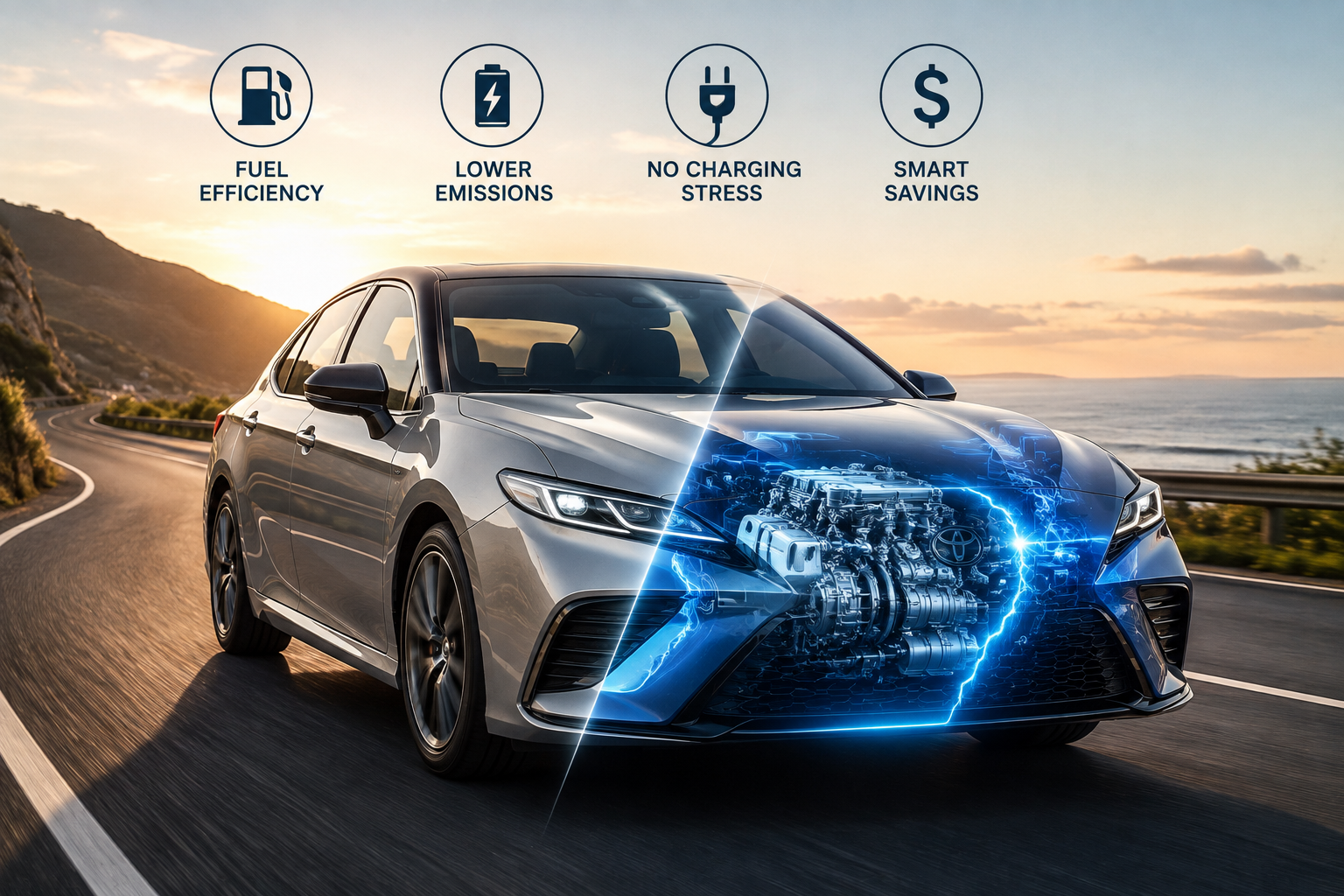
That phrase carries everything. Because the central promise of the hybrid — the thing that every salesperson says and every brochure implies — is that you get meaningfully better fuel economy and lower emissions and, in many cases, a smoother, more refined driving experience, and in exchange for all of that you have to change exactly nothing about your life.
You still stop at the same petrol station. You still fill up in the same three minutes. You don't need to plan routes around charger locations. You don't need to install anything at home. You don't need to check an app before a long journey to make sure the charging infrastructure will cooperate. You do not need to sit in a motorway services car park for thirty minutes wondering whether the fast charger you drove forty miles to reach will actually be working when you get there.
<cite index="21-1">With a hybrid, you don't have to do anything different than with fueling a gas-only car. You get better fuel economy and pollute less — offering a great solution for consumers who are not ready to jump into a fully electric vehicle.</cite>
"Not ready" is not the same thing as ignorant, or resistant to change, or insufficiently forward-thinking. For the majority of car buyers in 2026, it means something much more practical: they live somewhere without easy home charging. They make regular long trips. They cannot confidently rely on the charging infrastructure that exists in their region. They have calculated, accurately, that a full EV requires changes to their life that a hybrid doesn't, and they have decided that those changes are not worth it yet.
This is not irrationality. It is a reasonable response to real-world conditions.
What the Numbers Behind the Numbers Say
<cite index="22-2">The average transaction price gap between EVs and gas-powered vehicles was roughly $6,200 in early 2026, according to Cox Automotive.</cite> That gap narrowed considerably from its peak of several years ago, but six thousand dollars is still six thousand dollars — and it sits on top of a purchase that already represents one of the largest spending decisions most households make.
When the $7,500 federal incentive existed, that gap effectively disappeared for buyers who qualified. When it expired in September 2025, something immediate and stark happened: <cite index="24-1">EV unit sales fell by under 21 percent year over year in Q2 2026 — well better than the 27 percent of the first quarter, and the 36 percent drop in the final quarter of 2025.</cite>
A 36-percent quarterly drop. For context, that is not a market segment having a bad quarter. That is a market segment experiencing a structural shock. When the incentive that made EVs financially competitive with alternatives was removed, buyers who were on the fence moved — almost unanimously — toward the hybrid.
And here's the detail that might matter most if you're thinking about resale rather than just the purchase: <cite index="22-3">hybrids have retained their value better than EVs in recent years.</cite> The used EV market in 2026 is a buyer's paradise precisely because used EV values have softened significantly. <cite index="22-4">Used EV sales jumped 27.7 percent in March from a year earlier, and 44 percent of used EVs sold that month were priced below $25,000.</cite>
If you bought an EV at the top of the market, its residual value story is not a comfortable one. Hybrid residuals, meanwhile, have held up. The car that doesn't require an infrastructure commitment from the buyer doesn't carry that infrastructure risk in its resale price either.
The Infrastructure Problem Nobody Solved
The charging network has improved significantly since the early EV days. This is genuinely true. The number of public fast chargers has grown, reliability has improved in some regions, and the inter-operability between different networks has gotten less maddening than it was.
But "improved" and "solved" are different things.
<cite index="25-1">The surge in hybrid sales represents a pragmatic pivot, where buyers are seeking the efficiency and environmental benefits of electrification without the perceived risks and limitations associated with pure BEVs. This trend is largely driven by a misalignment between the proliferation of electric vehicles and the actualization of charging infrastructure.</cite>
The early wave of EV buyers — statistically, households with higher incomes, detached homes with garages, shorter average commutes, and access to workplace charging — found the experience broadly workable because their circumstances suited it. The mass market is a different population with different circumstances. Apartment dwellers without dedicated parking. Rural drivers with long distances between any charging options. People who do regular road trips and find the charging stop calculus too uncertain to be comfortable.
For all of these buyers, the hybrid doesn't represent a compromise. It represents a car that works. And in 2026, "works without requiring anything special from me" is turning out to be an extremely powerful product proposition.
<cite index="25-2">For the average consumer in 2026, the hybrid serves as a bridge technology. PHEVs in particular have seen a rise in popularity because they allow for short-distance electric commuting while retaining the flexibility of a combustion engine for long-distance travel. This versatility makes the hybrid an attractive proposition in a fluctuating economic environment where convenience and reliability are paramount.</cite>
The Manufacturers Read the Room
Something significant happened in the 2026 model year that illustrates how seriously manufacturers are taking the hybrid shift. <cite index="18-1">Some top sellers, like Toyota's RAV4 SUV and Camry sedan, and Jeep's reborn Cherokee SUV, are available only as hybrids in the 2026 model year.</cite>
Let that sit for a moment. The Toyota RAV4 — for years the best-selling non-truck vehicle in the United States — is now available exclusively as a hybrid. Toyota didn't offer it as an option alongside a standard version. They made the call that the hybrid is the version, full stop.
This is not a small manufacturer experimenting with a niche product. This is Toyota, which has sold more hybrid vehicles than any other company in history and whose data on what buyers actually want spans three decades, making a product decision that treats hybrid as the default rather than the upgrade.
<cite index="23-1">Automakers are executing a decisive strategic pivot from pure electric vehicles to hybrids as a direct response to unreliable government subsidies and a demonstrated slowdown in mainstream EV adoption. The aggressive "EVs-at-all-costs" approach of the early 2020s has given way to a more pragmatic, profit-driven focus on hybrids as a bridge technology for 2026 and beyond.</cite>
Ford delayed its Oakville EV plant from 2025 to 2027 in favour of hybrid production. Honda's Alliston plant was retooled for hybrid manufacturing. These are not tentative, speculative decisions. These are capital commitments made by companies that can read a market.
What the Hybrid Actually Feels Like in 2026
This is the part that rarely makes it into the market data reports but might be the most important piece of the whole story.
A modern hybrid — particularly the latest generation of Toyota and Hyundai systems — doesn't feel like a compromise between a petrol car and an electric one. It feels like a very good car that happens to be unusually economical and unusually smooth. The transition between electric and combustion power in the best current systems is essentially imperceptible. The regenerative braking is calibrated to feel like ordinary braking rather than the peculiar sensation that put early adopters off. The claimed fuel economy figures are achievable in real-world conditions in a way that EV range figures, which depend heavily on temperature and driving speed and charging infrastructure, often aren't.
A Toyota RAV4 Hybrid returns somewhere between 38 and 42 miles per gallon in mixed real-world driving conditions. In a vehicle of that size, in 2026 fuel prices, the savings over a comparable petrol-only SUV are meaningful over even a modest annual mileage. Not Tesla-running-almost-free meaningful, but genuinely significant at the pump, every month, for the entire ownership period.
And at the end of that ownership period, you sell it into a resale market that understands it, values it well, and doesn't require the buyer to immediately worry about battery degradation or replacement costs.
The Question the Data Answers
Did hybrid cars win the game before the full EV future arrived?
The honest answer is that no powertrain has permanently won anything. The EV future is still coming. Charging infrastructure will continue to improve. Battery costs will continue to fall. The proportion of buyers for whom a full EV is the right choice will grow, probably significantly, over the next decade.
But "the EV future is coming eventually" is very different from "the EV future is here now for most buyers." <cite index="22-5">Experts say hybrids are resonating with buyers because they offer better fuel economy than gas-powered cars without many of the charging concerns or lifestyle changes that can come with fully electric vehicles.</cite>
In 2026, for the majority of car buyers in most markets, the hybrid is not a stepping stone or a reluctant compromise. It is the vehicle that offers the best practical combination of lower running costs, no infrastructure dependency, strong resale value, and a driving experience that asks nothing unusual of the person behind the wheel.
That's not a consolation prize. That is, by most reasonable definitions, the smartest choice available in the current market.
The market seems to have figured that out. The numbers are just confirming what buyers already decided.
(Image suggestions: Toyota RAV4 Hybrid 2026 in motion exterior / hybrid vs EV charging comparison side by side / hybrid car fuel efficiency dashboard display / Cox Automotive hybrid sales surge chart 2023–2026 / Hyundai Tucson Hybrid real world driving)
Leave a Comment
Your comment will appear after moderation.