Others are ignored, criticized, or even laughed at.
There's a strange kind of heartbreak reserved for things that were too good, too soon. A song nobody streams until the artist is gone. A startup that builds the right product for a market that doesn't exist yet. And in the world of cars, there's an entire graveyard of machines that engineers basically built from the future and dropped into a showroom where nobody was ready to buy them.
We tend to assume the market rewards genius. It doesn't. It rewards timing. And nowhere is that more obvious — or more tragic — than in the history of automobiles that were so far ahead of their era that they scared people off, broke under their own ambition, or simply got crushed by the industry they were trying to outpace.
Some of these cars bankrupted the companies that built them. Some were destroyed in scrapyards on purpose. One was literally squashed flat by the very company that made it, decades later, while owners begged on their knees to keep it. Let's go through the ones that deserve a second look — and maybe a little grief.
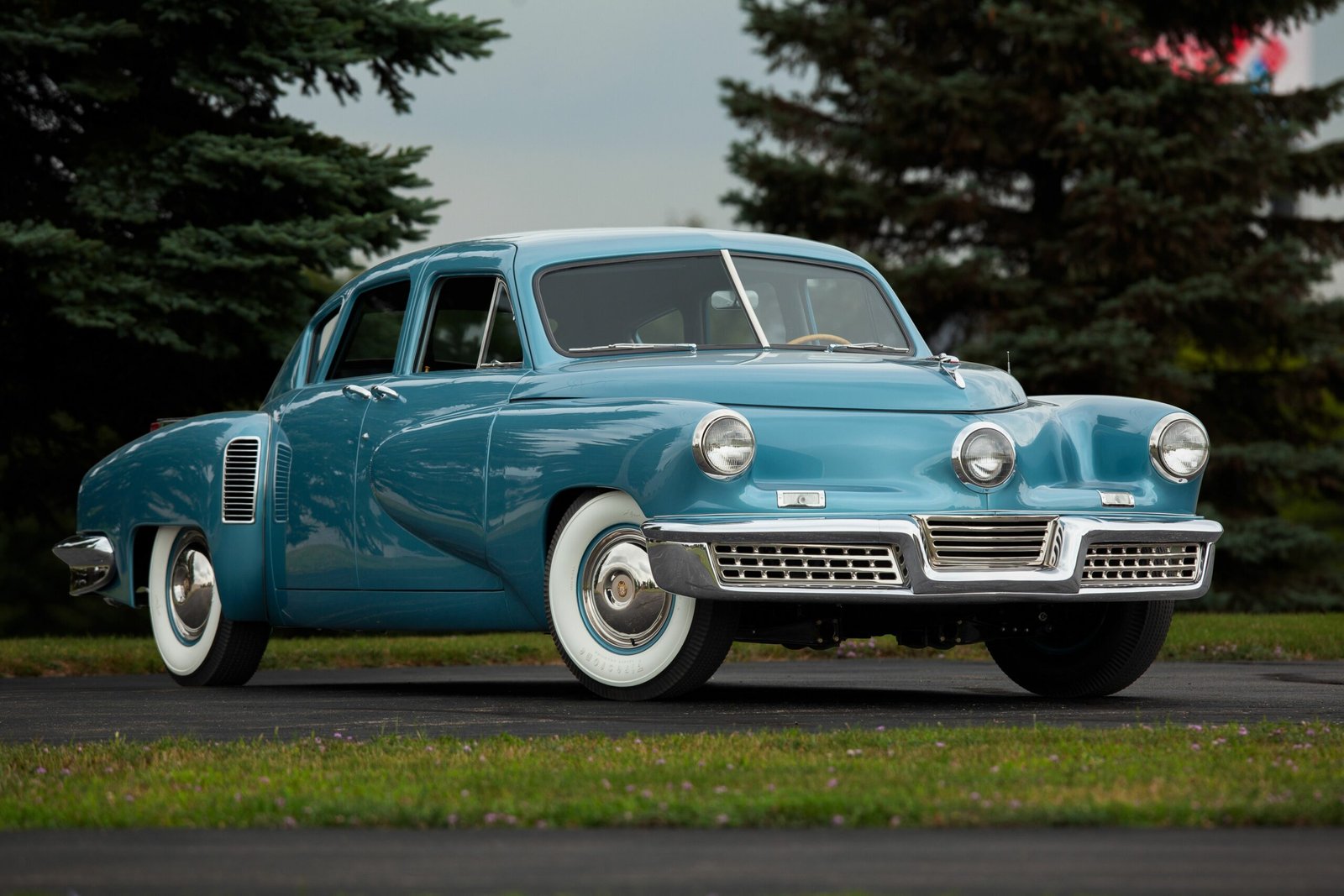
1. The Tucker 48 — The Car Detroit Allegedly Couldn't Let Live
In 1948, a guy named Preston Tucker rolled out a sedan with a padded dashboard, a pop-out safety windshield, disc brakes, and a third headlight in the centre that turned with the steering wheel to light up corners — features that wouldn't become standard for thirty or forty years. This was happening while most American cars still treated "safety feature" as a punchline.
What happened next reads like a thriller. The Securities and Exchange Commission opened an investigation into Tucker's company, the press tore into him, and rumours swirled that the Big Three automakers and a sympathetic Michigan senator had a hand in making the trouble go away. Tucker was eventually acquitted of every single charge in court. It didn't matter. By then his company was already dead. Only 51 Tucker 48s were ever built, and the world didn't get its safety sedan until Volvo and others reinvented the idea decades later.
(Image idea: a 1948 Tucker 48 sedan, front three-quarter view showing the centre "cyclops" headlight.)
2. The Tatra 77 — The Streamlined Ghost Behind the VW Beetle
Long before anyone in Detroit had heard the word "aerodynamics," a small Czechoslovak company called Tatra built a teardrop-shaped sedan with a rear-mounted air-cooled V8, magnesium-alloy parts, and a drag coefficient so low it's still impressive by today's standards. It looked like nothing else on the road in 1934 — because nothing else on the road had been shaped in a wind tunnel.
The Tatra 77 didn't fail commercially in the usual sense; it was always a low-volume luxury halo car. But its real tragedy is bigger than sales charts. Its ideas — the rear engine, the rounded, slippery shape, the air cooling — were so good that Ferdinand Porsche borrowed heavily from them while designing what became the Volkswagen Beetle, a legal dispute Tatra didn't get compensated for until decades later. Then Nazi Germany occupied Czechoslovakia, and the company that dreamed up the future of car design got swallowed by the very war its ideas should have outlived.
(Image idea: a 1934 Tatra 77, rear three-quarter angle showing the dorsal fin and sloped tail.)
3. The Chrysler Turbine Car — A Jet Engine You Could Park in Your Driveway
Picture this: it's 1963, and Chrysler hands out fifty turbine-powered cars to ordinary American families for free, just to see what happens. The engine could run on diesel, kerosene, peanut oil, or — according to legend — perfume, if you were feeling reckless. It had a fraction of the moving parts of a normal engine, barely vibrated, and sounded like a small aircraft idling in your garage.
Two hundred and three families drove these things for three months apiece, racking up over a million miles between them, and most of them loved it. The problem wasn't the dream. It was the math. Each car reportedly cost somewhere north of fifty thousand dollars to build at a time when a normal family car cost around three thousand. When the program ended, Chrysler shipped most of the fleet straight to a scrapyard — partly, depending who you ask, to dodge import duties on the Italian-built bodies. Only nine of the original fifty-five survive today, scattered across museums and Jay Leno's garage.
(Image idea: a 1963 Chrysler Turbine Car in "turbine bronze" paint, parked outside a vintage building.)
Did You Know?
The Tucker 48 introduced several safety ideas nearly 30 years before they became common in family cars.
4. The NSU Ro80 — The Car So Smooth, It Sank a Whole Company
In 1967, a small German manufacturer called NSU put out a sedan so advanced that it won European Car of the Year practically by acclamation. Front-wheel drive, four-wheel disc brakes, fully independent suspension, and a Wankel rotary engine so silky that period reviewers compared it to a turbine. It looked like nothing on the road, and journalists genuinely struggled to find a rival for it.
Then the engines started dying — sometimes before owners had put fifteen thousand miles on the clock. NSU, to its credit, kept honouring warranty claims and replacing rotary engines for free, which is a lovely thing to do and a terrible way to stay solvent. The warranty bill effectively bankrupted the company, which Volkswagen swallowed up not long after — mostly for its factories and its compact K70, not the Ro80 itself. What's left of NSU lives on today in the bones of the modern Audi.
(Image idea: a 1967 NSU Ro80 sedan, side profile showing its wedge-shaped, six-window glasshouse.)
5. The Citroën SM — A French Spaceship With an Italian Heart
Citroën had already terrified and delighted the world once, with the hydropneumatic, self-levelling DS in 1955. Then in 1970 they doubled down with the SM: a Maserati V6 wrapped in a Citroën body with self-centring power steering, headlights that swivelled into corners, and a suspension so advanced that journalists genuinely struggled to describe what it felt like to ride in one. It won Motor Trend's Car of the Year in the U.S., a near-unthinkable honour for a French car at the time.
And then the 1973 oil crisis hit. Sales fell off a cliff almost overnight, the fragile Maserati engine developed a reputation for chewed-up timing chains, and U.S. safety regulators effectively outlawed its swivelling headlight design out of the American market entirely. Citroën pulled the plug in 1975, having lost a fortune developing a car that was, by most accounts, one of the most genuinely advanced grand tourers ever built.
(Image idea: a 1970s Citroën SM coupe, low and sleek front view with its distinctive glass-covered headlight cluster.)
6. The GM EV1 — The Electric Car That Got Crushed on Purpose
Long before Tesla existed, before Elon Musk was anything more than a Stanford student, General Motors built a purpose-designed electric car from scratch. Not a converted gas model — a ground-up EV with a drag coefficient lower than almost anything else on the road, regenerative braking, and a heat-pump climate system. It was, in nearly every meaningful technical sense, decades ahead of the EVs that would eventually take over the market.
GM never sold a single one. The EV1 was lease-only, available in a handful of states, and when the leases ran out, GM took every car back and crushed almost all of them, despite drivers begging — literally holding a candlelight vigil — to keep theirs. Roughly forty survived, mostly disabled, sitting in museums. It later became the subject of a documentary bluntly titled Who Killed the Electric Car?, and it's hard to watch footage of those cars going into the crusher without feeling like you're watching someone bury a working time machine.
(Image idea: a 1996 GM EV1 in profile, showing its smooth, fully enclosed rear wheel arches.)
7. The Honda Insight — First to the Hybrid Party, First to Leave
Seven months before the Toyota Prius ever touched American soil, Honda quietly launched the Insight: a two-seat, aluminium-bodied hybrid with a teardrop shape and a fuel economy rating — 70 mpg highway — that no gas-powered car has matched in America since. It was lighter, slipperier, and arguably more technically pure than the Prius that would go on to define an entire category.
But Honda built it almost like a research project wearing a price tag, never expecting big volume, and buyers took one look at the two-seat layout and the slightly odd, bubble-like styling and walked straight past it toward the much more practical, four-door Prius instead. Honda had hoped for 6,500 sales a year; over seven years it sold barely 17,000 worldwide. The Prius, meanwhile, went on to sell in the millions. Sometimes being first just means you're the one who pays to educate the market for everyone else.
FINAL THOUGHT
Looking back, it's easy to admire these machines.
Looking forward, it's harder to recognize the next one.
Somewhere in a showroom today sits another car people are calling strange, overpriced, unnecessary, or unrealistic.
Twenty years from now, it may become a legend.
Because history rarely rewards the first genius.
It rewards the one who arrives when the world finally catches up
So What Do These Cars Actually Have in Common?
None of them failed because the engineering was wrong. The Tucker really was safer. The Tatra really was more aerodynamic. The Ro80 really did ride and handle like nothing else from 1967. What killed them, almost every time, was some combination of cost, timing, fragile new technology nobody had learned to maintain yet, or a market that simply wasn't emotionally or economically ready for the leap being asked of it.
There's something almost comforting in that, honestly. It means the next genuinely brilliant, doomed car is probably sitting in a showroom right now, quietly confusing people who aren't ready for it yet — and in thirty years, someone will write exactly this kind of article about it.
Leave a Comment
Your comment will appear after moderation.