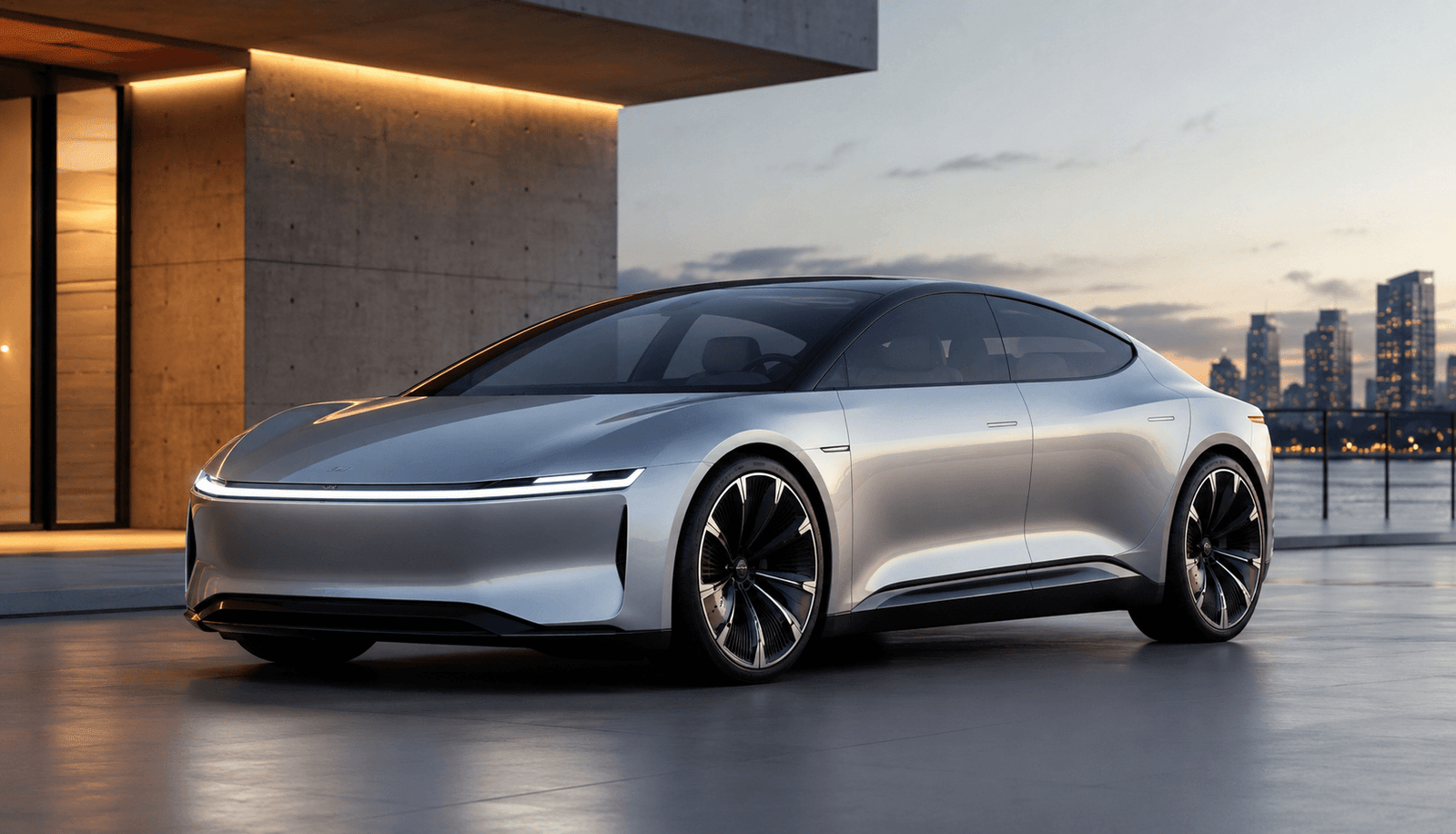
Imagine Getting Into a Car With No Steering Wheel
Picture this: Monday morning. You walk out of your house, coffee in one hand, keys in the other — except there are no keys. There's no reason for keys. A car pulls up in front of your gate, silent as a fridge, and the door opens on its own.
You sit down.
There's no steering wheel. No pedals. No gear lever. Just... seats. Comfortable ones, actually, facing each other like a tiny drawing room on wheels. You tell it where you want to go. It moves. You arrive.
And somewhere in the back of your mind, something feels very, very wrong.
I've been thinking about this more than I'd like to admit. Because the autonomous car conversation has been going on for what — ten, fifteen years now? And every year someone publishes a headline saying we're "five years away." We've been five years away since 2012. But this time it actually feels different. Not because the technology suddenly works perfectly, but because the question has quietly shifted.
We stopped asking can we build a self-driving car. We started asking: when we do — do we keep the steering wheel at all?
That sounds dramatic. But Waymo is already running driverless robotaxis in parts of the US with no backup driver. Some concepts being floated for the next generation of these vehicles don't even include controls as an option. Not hidden, not retractable. Just... gone. The assumption being that if the car is always going to drive itself, why bother with the theatre of pretending you could take over?
And okay, fine. From a pure engineering standpoint that makes sense. But from a human standpoint — I'm not sure we've thought this through properly.
Here's the part the tech optimists always skip over: people aren't afraid of self-driving cars because they don't understand the technology. They're afraid because they understand themselves.
Think about how it actually feels to sit in the passenger seat when someone else is driving. Even when that person is perfectly competent. There's a constant, low-level hum of anxiety. Your foot presses an invisible brake. Your hand drifts toward the dashboard. You're not scared of the driver — you're just not in control. And that is uncomfortable in a way that's very hard to reason your way out of.
Now multiply that by an algorithm you can't talk to, read, or even make eye contact with.
Humans forgive other humans for mistakes. We understand distraction, misjudgment, bad luck. But when a machine makes a mistake — even a small one — it becomes a scandal. An investigation. A congressional hearing. The bar for machines is essentially perfection, and that pressure is enormous. Not just for the engineers, but for the poor passenger sitting in a sealed box on the motorway, watching the road disappear under them with no wheel in front of them to grab if something goes wrong.
I'm not saying the technology is bad. I'm saying trust is not a technical problem. It doesn't improve with software updates. It has to be earned, slowly, incident by incident, year by year — and one bad incident can erase a decade of goodwill overnight.
That's just how people are.
But let's say it works. Let's say in twenty years, the software is genuinely excellent, the infrastructure is there, and fully autonomous vehicles are the norm. What then?
Honestly? I think driving becomes what horse riding became.
At one point horses were transportation. Necessary, practical, the only option. Today almost nobody rides a horse to get somewhere. But people still ride horses — on weekends, at clubs, because they love it. Because there's something about controlling a large, powerful animal that feels good in a way a car or bus cannot replicate.
Driving might go exactly the same way. Not dead. Just... recreational. You'd take the autonomous pod to work. But on a Sunday morning, on a clean road somewhere in the mountains, you'd want your hands on a wheel. The smell of petrol. The weight of a gear change. And it wouldn't be transportation — it'd be a hobby.
Which is a strange thought. But not entirely a sad one, actually.
The interior design people are already having a field day with this. Without a driver, the front-facing layout of a car becomes pointless. Why should everyone face the same direction? Why should there be a "front" at all? Rotating seats, fold-out workstations, full entertainment setups — some concepts look less like a car and more like a first-class cabin from an airline that got lost.
There's something genuinely exciting about that. Commutes that become usable time instead of wasted time. Elderly people who can no longer drive safely, regaining independence. People in cities who never learned to drive in the first place, finally able to get somewhere difficult without relying on patchy public transport.
Those are real benefits. I'm not being sarcastic.
But car culture. That's the conversation nobody wants to have.
There are people for whom cars are not transportation. They are passion, identity, community. The feel of an engine under a bonnet. The sound of a good exhaust note. The satisfying click of a well-weighted gear lever. That world doesn't map onto an autonomous pod, no matter how comfortable the seats are.
Would the next generation even care about cars the way their parents did? Maybe not. Maybe for them a car is just an Uber with no driver, and that's genuinely fine, because they grew up that way. But something would be lost. I don't know exactly what to call it. Some combination of craftsmanship, skill, and the particular pleasure of doing something physical well.
Anyway. The future is coming. Faster than feels comfortable.
The question at the centre of all of this isn't really about technology. It's much simpler and much harder than that.
When the car no longer needs you...
Do you actually want to stop driving?
Some people will say yes, instantly and without regret. Others will never let go voluntarily.
Both are honest answers. And neither is wrong.
The wheel has been in our hands for over a century. What happens when it isn't — that's not something engineers can decide for us. That's something we'll have to work out ourselves.
Leave a Comment
Your comment will appear after moderation.