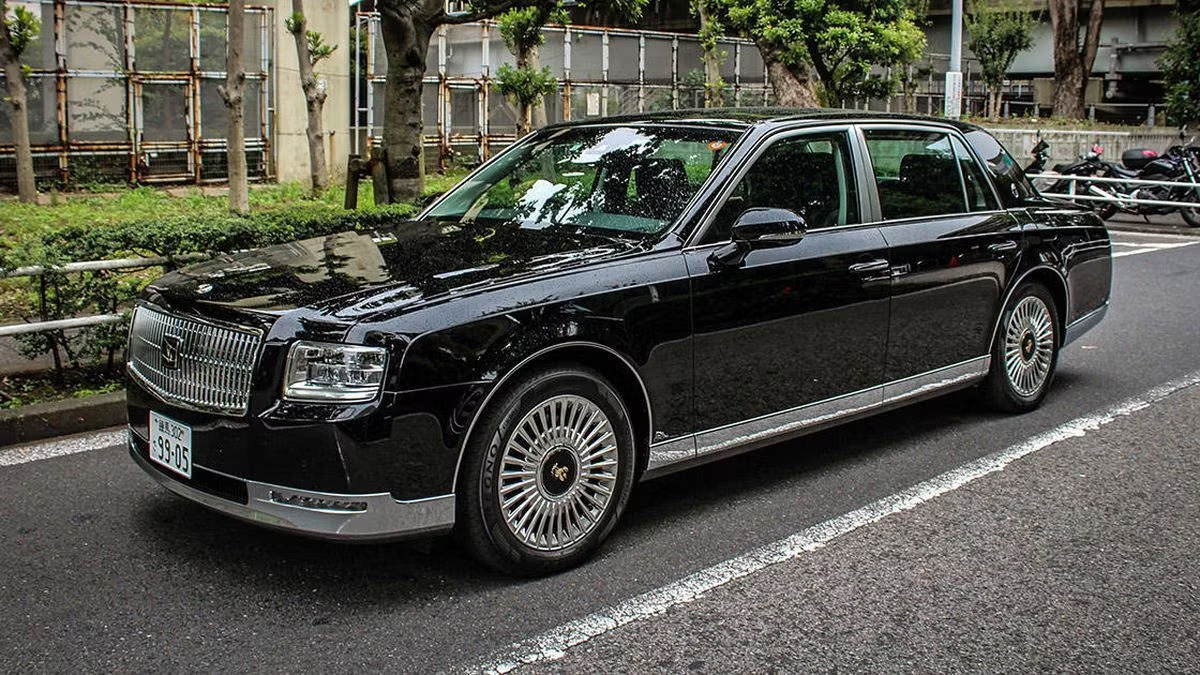
There is a specific sound a truly expensive car makes when you close its door. Not a thud, not a click — more like a quiet, pressurised seal, as if the outside world just ceased to exist. Most people have never heard it, because most people are looking at the wrong cars.
The conversation about what billionaires drive is almost always wrong, because it almost always starts with Bugatti. With LaFerrari. With the chrome-wrapped Lamborghini parked outside a hotel in Monaco with a fourteen-year-old influencer standing next to it for scale. Those cars exist. Some extremely wealthy people own them. But if you actually studied the parking lots of serious money — the family offices in Greenwich, the private members clubs in Mayfair, the corporate headquarters in Tokyo — the cars you'd see most often wouldn't be on anyone's dream-car poster.
They'd be long. Black. Utterly anonymous from the outside. And inside, they'd cost more per square centimetre than almost anything in a showroom.
This is what serious money actually drives. And the reasons why are more interesting than the cars themselves.
The Philosophy Comes First
Before getting to the specific machines, it helps to understand the mindset, because without it the choices don't make sense.
There's a phrase that's been circulating in finance and old-money circles for decades, but only recently found its way into mainstream conversation: stealth wealth. The idea is simple enough. People who have accumulated real, generational money — not lottery winners, not debut-album earners, not recently-IPO'd founders on their first week of liquid — tend to be allergic to display. Not out of modesty, exactly, but out of something closer to taste. When you've had money long enough, you stop needing to prove it to strangers.
There's also a more practical reason, one that security consultants have been quietly advising wealthy clients about for years. A visually distinctive vehicle — a blinding-orange hypercar, a Rolls with the chrome Spirit of Ecstasy catching sunlight — is trivially easy to track across a city. Anyone with a phone and a vantage point can photograph it, identify it, time it, follow it. In a world where kidnapping for ransom has become an organised industry in certain regions, and where social media can turn a parked car into a trending photograph in ninety seconds, driving something that announces itself is not just tasteless. It is, in the assessment of people who think professionally about these things, actively dangerous.
So the question of what serious money buys becomes, at a certain level, not what's fastest or most exclusive, but what's most invisible. And the answer to that question is surprisingly specific.
The Toyota Century — Japan's Best-Kept Secret
If you don't know what a Toyota Century is, that's precisely the point.
Since 1967, Toyota has manufactured a small-volume, full-size sedan for Japanese prime ministers, members of the Imperial House, and the country's most senior corporate executives. It does not carry the Toyota oval badge. It does not have a visible logo outside Japan. It is assembled almost entirely by hand. The door hinges are engineered to move at a specific, deliberate pace — not snapping shut, but pulling closed with a soft, pneumatic finality that costs more to manufacture than most cars' entire door assemblies.
The interior uses Nishijin-ori silk — a weave so labour-intensive it comes from Kyoto workshops that have been operating for centuries. The wood trim comes from craftsmen, not from automated panels. The current hybrid powertrain operates in near-silence on electric power alone for extended stretches, not because Toyota was trying to be eco-conscious, but because silence is the entire point. Marketing materials for the Century have historically said something to the effect that the car is "acquired through persistent work, the kind done in a plain but formal suit." That line was not written for the Western market. It was written for people who consider a Rolls-Royce a little obvious.
Outside Japan, the Century remains almost unknown. That's not an accident. In fifty years of production, Toyota reportedly sold fewer than 100 examples outside its home market. If you see one — in any city on earth — the person sitting in the rear seat has arrived at a level of wealth and influence that doesn't require explanation to anyone else in the vehicle.
The Mercedes-Maybach S-Class — The Car That Hides in Plain Sight
The genius of the Mercedes-Maybach S-Class is that it looks, from the outside, like a well-specced Mercedes S-Class. Which is to say: yes, it's clearly an expensive car, but it reads as the car of a successful professional — a senior partner, a regional director — rather than the car of someone who owns the firm and also three other firms.
What's inside is a different matter entirely. Reclining rear seats with massage functions, an interior trimmed in open-pore wood and undyed leather, a 6.0-litre twin-turbocharged V12 that moves two and a half tonnes of car with a quietness that has to be experienced to be believed. The Maybach S680 starts at well over two hundred thousand dollars in most markets. From the outside, at a stoplight, nobody can tell.
Contrast this with a Bentley Mulsanne or a Rolls-Royce Phantom, both of which announce themselves visibly from three blocks away. <cite index="37-1">The Mercedes-Maybach is designed to appeal to the super wealthy who don't want to make a statement.</cite> That audience turns out to be larger than the automotive press ever expected.
The Range Rover — But Not the One You're Thinking Of
The Range Rover is, on paper, one of the most visible luxury cars on earth. It's enormous. It's everywhere. Every footballer and rapper and reality-television personality seems to have one.
And yet, if you specify a long-wheelbase Range Rover in a matte dark colour — no chrome, privacy glass, no contrast roof, no personalisation pack — something interesting happens. It becomes, paradoxically, invisible. Because everyone expects that car to belong to exactly the kind of person who wants to be seen. So when it belongs instead to someone who actively does not want to be identified, it works perfectly as a disguise.
<cite index="34-1">Security consultants increasingly advise prominent clients against visually distinctive vehicles, which are trivially easy to track across a city by anyone with a phone. Privacy, always a luxury, has become a security requirement. The understated car is not only tasteful; it is tactically sound.</cite>
The long-wheelbase Range Rover ticks a very specific set of boxes for this buyer. It is genuinely enormous inside, which matters if the rear seat is your mobile office. It has the ground clearance and the drivetrain to go anywhere, which matters if your schedule takes you to places where infrastructure is unreliable. And in its quietest specification, it is a different vehicle entirely from the one sold to the general luxury market.
The Rolls-Royce Ghost — Even Rolls-Royce Went Quiet
Here is a remarkable thing. Rolls-Royce, the company whose products are the global symbol of conspicuous luxury, introduced its Ghost model specifically under a philosophy they called "post-opulence." The idea was that their most discerning customers — the ones with real, multi-generational wealth — had grown uncomfortable with the sheer loudness of the Phantom. They wanted the craft and the engineering, but not the visual declaration.
The Ghost, as a result, is plainer. Less ornamented. Smaller in its proportions. Quieter, in the sense of less decorated, though inside it is as meticulous as anything Rolls-Royce has ever made. The Phantom says: look at me. The Ghost says: I know what I am, and I don't need you to know it too.
<cite index="34-1">The Rolls-Royce Ghost — marketed by its own maker under the philosophy of "post-opulence" — was prophetic here. Alongside it: the Range Rover in black on black, the Mercedes-Maybach with the two-tone paint deleted, the Porsche Taycan in colours that photograph like fog. Performance remains absolute. Presentation whispers.</cite>
That sentence — performance remains absolute, presentation whispers — is probably the best single description of what old money drives that has ever been written.
Bill Gates Has a Porsche. But Not the One You'd Guess.
Bill Gates is known to be an enthusiast of Porsche. Not as a status symbol — Gates has said publicly that he buys Porsches because he finds them genuinely interesting as engineering objects, and because Porsche 911s are cars you can actually drive rather than just be driven in. He has owned a Porsche 959, a car so technically advanced when it was built that the US couldn't legally import it under existing safety laws. He also drives a Porsche 911. Both are famous cars. Neither is a hypercar chosen for maximum visibility.
This is the other category of wealthy-person car choice: the genuine enthusiast. Not the collector buying for investment or for Instagram, but the person who actually knows why a specific car is interesting and chose it for that reason alone. These buyers tend to have a marked preference for the Porsche 911, the Lexus LC 500, the Bentley Continental GT in understated colours, and occasionally something old and genuinely significant that most people on the street wouldn't recognise.
Mark Zuckerberg, for all the obvious jokes, drives a Honda Fit. He also owns an Acura TSX and a Volkswagen Golf GTI. He could buy any car on earth. He has chosen, repeatedly, not to.
What This Actually Tells You
<cite index="18-1">Walk through Greenwich, Connecticut on any given Tuesday morning. You'll spot more Honda Accords than Lamborghinis. Meanwhile, Silicon Valley's tech billionaires cruise by in decade-old Camrys while the guy desperately trying to look wealthy finances a Mercedes he can't afford.</cite>
The pattern, once you see it, cannot be unseen. <cite index="18-1">According to research from Experian Automotive, 61% of wealthy Americans earning $250,000 or more drive mainstream brands like Honda, Toyota, and Ford.</cite> That figure does not account for ultra-high-net-worth individuals — billionaires, not merely millionaires — who tend to skew even further toward either exceptional discretion or very specific enthusiast choices.
The truly wealthy have, in general, moved past the phase of using cars as social signals. They've reached the point where what the car looks like to strangers is essentially irrelevant, and what it actually does — how it sounds at low speed in a tunnel, how the leather develops with use, how the suspension reads an imperfect road — is the only thing that matters.
The Cars That Don't Have Instagram Accounts
There's an easy test for whether a car belongs in this conversation. Does it appear regularly in social media posts? Is it the kind of car someone would hire for a photoshoot background? Does it come with a waiting list that's itself a status symbol, something people talk about at dinner?
If yes, it's probably not what the serious money is actually driving.
The Toyota Century doesn't have an official social media presence in most markets. The Rolls-Royce Ghost's specific appeal is that it photographs like a large, well-proportioned sedan rather than a rolling monument. The Mercedes-Maybach's most devoted owners chose it specifically because their doormen recognise what it is and nobody else does.
This is a particular kind of luxury — the kind that requires existing knowledge to appreciate. It's the automotive equivalent of a watch that tells excellent time and has no visible logo. It is, in the end, a very old idea: that the best things don't need to announce themselves, and the people who know what they're looking at are the only audience worth having.
The rest of us are standing next to a Lamborghini in a hotel forecourt, wondering why the person who actually owns the building just walked past in a black sedan without even glancing over.
Leave a Comment
Your comment will appear after moderation.