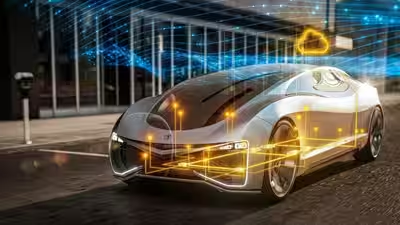
Imagine This...
You're driving home late at night on an empty highway.
The music is playing.
Your navigation is guiding you home.
Suddenly, the radio changes by itself.
The air conditioning turns on.
The dashboard flashes with warning lights.
The doors lock automatically.
Your steering wheel feels different.
Your heart starts racing.
Someone isn't sitting in your car.
They're sitting behind a computer.
And somehow... they've found a way inside.
It sounds like something straight out of a Hollywood movie.
But here's the unsettling truth:
Modern cars are no longer just machines.
They're computers on wheels.
And like every connected computer, they can become targets.
Your Car Is Smarter Than Ever Before
A modern vehicle isn't just an engine with four wheels.
Today's cars contain dozens of tiny computers called Electronic Control Units (ECUs).
Each one controls something important.
Steering
Braking
Engine performance
Airbags
Cruise control
Parking assistance
Climate control
Infotainment
Navigation
These systems constantly communicate with each other.
That's what makes modern driving feel effortless.
But every connection also creates another possible point of entry.
The Internet Has Entered Your Garage
Years ago, cars stayed offline.
Now they're always connected.
Many vehicles communicate using:
Wi-Fi
Bluetooth
GPS
Cellular networks
Cloud services
Smartphone apps
Manufacturers love these features because they allow:
Remote engine start
Vehicle tracking
Live traffic updates
Software updates
Voice assistants
Emergency services
Convenience has never been greater.
Neither has digital risk.
What Exactly Is a Connected Car?
A connected vehicle exchanges information with other devices.
Sometimes it's your smartphone.
Sometimes it's the manufacturer's servers.
Sometimes it's nearby vehicles.
Sometimes even traffic lights.
This technology makes driving safer and smarter.
But it also means your car is constantly sending and receiving data.
The question isn't whether data is being shared.
The question is who can access it.
Your Car Knows More About You Than You Think
Most drivers don't realize how much information their vehicles collect.
Depending on the model, your car may store:
Home address
Frequently visited places
Driving habits
Fuel usage
Voice commands
Phone contacts
Text message history
Music preferences
Bluetooth devices
GPS routes
Some luxury vehicles can even monitor driver attention and fatigue.
The goal is safety.
But it also means your vehicle knows an incredible amount about your daily life.
Can Someone Really Hack a Car?
The short answer is yes.
But it's important to keep this in perspective.
Most cars are not easily hacked by random people driving down the street.
Modern manufacturers include many layers of security.
However, cybersecurity researchers have repeatedly demonstrated that vulnerabilities can exist.
In controlled tests, researchers have shown ways to interfere with certain vehicle systems after exploiting software flaws.
These demonstrations are intended to help manufacturers improve security before criminals can take advantage of the same weaknesses.
Why Cars Are Becoming Targets
Cybercriminals follow one simple rule.
They attack wherever valuable information exists.
Connected vehicles contain:
Personal data
Payment information
Location history
Digital identities
Remote access systems
As cars become more connected, they naturally attract more attention from security researchers and, unfortunately, from criminals as well.
The Hidden Risk of Smartphone Apps
Many drivers love controlling their cars from an app.
Unlock doors.
Check fuel.
Locate the vehicle.
Start the engine.
It's incredibly convenient.
But if someone gains access to your phone account or password, they may also gain access to your connected vehicle services.
That's why strong passwords and two-factor authentication matter just as much for your car as they do for your email.
Bluetooth Isn't Always Harmless
Bluetooth is one of the most useful features inside modern vehicles.
It connects your phone in seconds.
But leaving Bluetooth permanently discoverable can expose unnecessary risks.
While serious attacks are uncommon, cybersecurity experts recommend turning off discoverable mode when it's not needed and keeping your vehicle's software updated.
Small habits can reduce unnecessary exposure.
Over-the-Air Updates: A Blessing and a Challenge
Modern cars can now receive software updates without visiting a dealership.
Manufacturers use these updates to:
Fix software bugs
Improve security
Add new features
Enhance performance
This is a huge advantage.
But it also means software has become one of the most important parts of your car.
Just like your smartphone or laptop, keeping your vehicle updated is one of the simplest ways to stay protected.
Convenience Always Comes With Responsibility
Technology makes driving easier than ever before.
But every new feature comes with a new responsibility.
The same systems that allow you to unlock your car from another city also need to be protected from unauthorized access.
As vehicles continue evolving into connected computers, cybersecurity becomes just as important as seatbelts and airbags.
Because in today's world, protecting a car isn't only about locking the doors.
Sometimes, it's about protecting the software behind them.
Real-World Cases That Changed the Auto Industry
For years, vehicle hacking sounded like science fiction.
Then cybersecurity researchers began proving otherwise.
In controlled demonstrations, experts showed that software vulnerabilities could sometimes allow remote access to certain vehicle functions after multiple security layers were bypassed.
These demonstrations weren't performed to frighten drivers.
They were designed to expose weaknesses before criminals could exploit them.
Every major automaker learned an important lesson:
A connected car must also be a secure car.
Can AI Protect Cars Better Than Humans?
Artificial intelligence isn't just creating smarter cars.
It's also becoming one of their strongest security guards.
Modern security systems can monitor thousands of signals every second.
If something unusual happens, AI can recognize patterns much faster than a human technician.
For example, an AI security system may notice:
Unusual login attempts
Unexpected software changes
Suspicious network traffic
Fake GPS signals
Unauthorized remote commands
Instead of waiting for damage to happen, AI can detect suspicious behavior early and alert the manufacturer or owner.
The same technology that powers self-driving features is increasingly helping defend connected vehicles against cyber threats.
GPS Isn't Always Telling the Truth
Most people completely trust their navigation system.
But GPS signals can sometimes be manipulated through a technique known as GPS spoofing.
Instead of blocking the signal, attackers attempt to send false location information.
Although these attacks are uncommon and usually require specialized equipment, they demonstrate why secure navigation systems are becoming more important every year.
Manufacturers continue improving defenses to reduce these risks.
What Happens If Someone Accesses Your Vehicle Data?
For many people, the greatest concern isn't someone taking control of the car.
It's privacy.
Modern vehicles may store:
Recent destinations
Driving history
Favorite locations
Connected smartphones
Voice assistant requests
Contact lists
Calendar information
If this information falls into the wrong hands, it could reveal far more about your daily life than you might expect.
That's why many manufacturers now encrypt stored data and allow owners to delete personal information before selling a vehicle.
How Car Manufacturers Fight Back
Automakers invest heavily in cybersecurity.
Many companies now employ teams whose only job is to search for software weaknesses before hackers find them.
Common protection methods include:
Encrypted communication
Secure software updates
Digital authentication
Firewalls inside vehicle networks
Intrusion detection systems
Continuous security testing
Some manufacturers even reward ethical hackers who responsibly report vulnerabilities through bug bounty programs.
Instead of treating researchers as enemies, they work together to make future vehicles safer.
How You Can Protect Your Connected Car
The good news is that most drivers can greatly reduce risk by following a few simple habits.
✔ Keep your vehicle software updated.
✔ Use strong, unique passwords for connected car accounts.
✔ Enable two-factor authentication whenever it's available.
✔ Remove old phones from the Bluetooth pairing list.
✔ Delete personal data before selling your vehicle.
✔ Install only official manufacturer apps.
✔ Avoid connecting to unknown public Wi-Fi networks through your vehicle.
These simple steps don't require technical knowledge, but they can significantly improve your digital security.
Are Fully Connected Cars Worth the Risk?
Despite the concerns, connected vehicles offer enormous benefits.
They can automatically call emergency services after a serious collision.
They provide real-time traffic information.
They receive software improvements without visiting a dealership.
They help prevent accidents through advanced driver assistance systems.
The goal isn't to fear technology.
It's to use it responsibly.
Every new innovation brings both opportunities and challenges.
Connected cars are no different.
The Road Ahead
The next generation of vehicles will be even more connected.
Cars will communicate with:
Other vehicles
Traffic lights
Parking systems
Charging stations
Smart cities
Artificial intelligence will make driving safer and more efficient.
At the same time, cybersecurity will become just as important as crash testing and engine reliability.
The automotive industry is no longer competing only in horsepower.
It's competing in digital security.
And that battle has only just begun.
Final Thoughts
Cars have evolved dramatically over the past two decades.
They are no longer simple mechanical machines.
They are intelligent, connected devices capable of learning, communicating, and constantly improving through software.
That transformation has made driving more convenient than ever before.
But it has also introduced a new responsibility.
Protecting your car today isn't only about locking the doors or parking in a safe place.
It's also about protecting passwords, updating software, and understanding the technology you rely on every day.
The good news is that manufacturers continue strengthening security, researchers continue discovering weaknesses before criminals do, and drivers have more tools than ever to protect themselves.
The future of connected vehicles is incredibly exciting.
But like every powerful technology, it works best when innovation and security move forward together.
Leave a Comment
Your comment will appear after moderation.