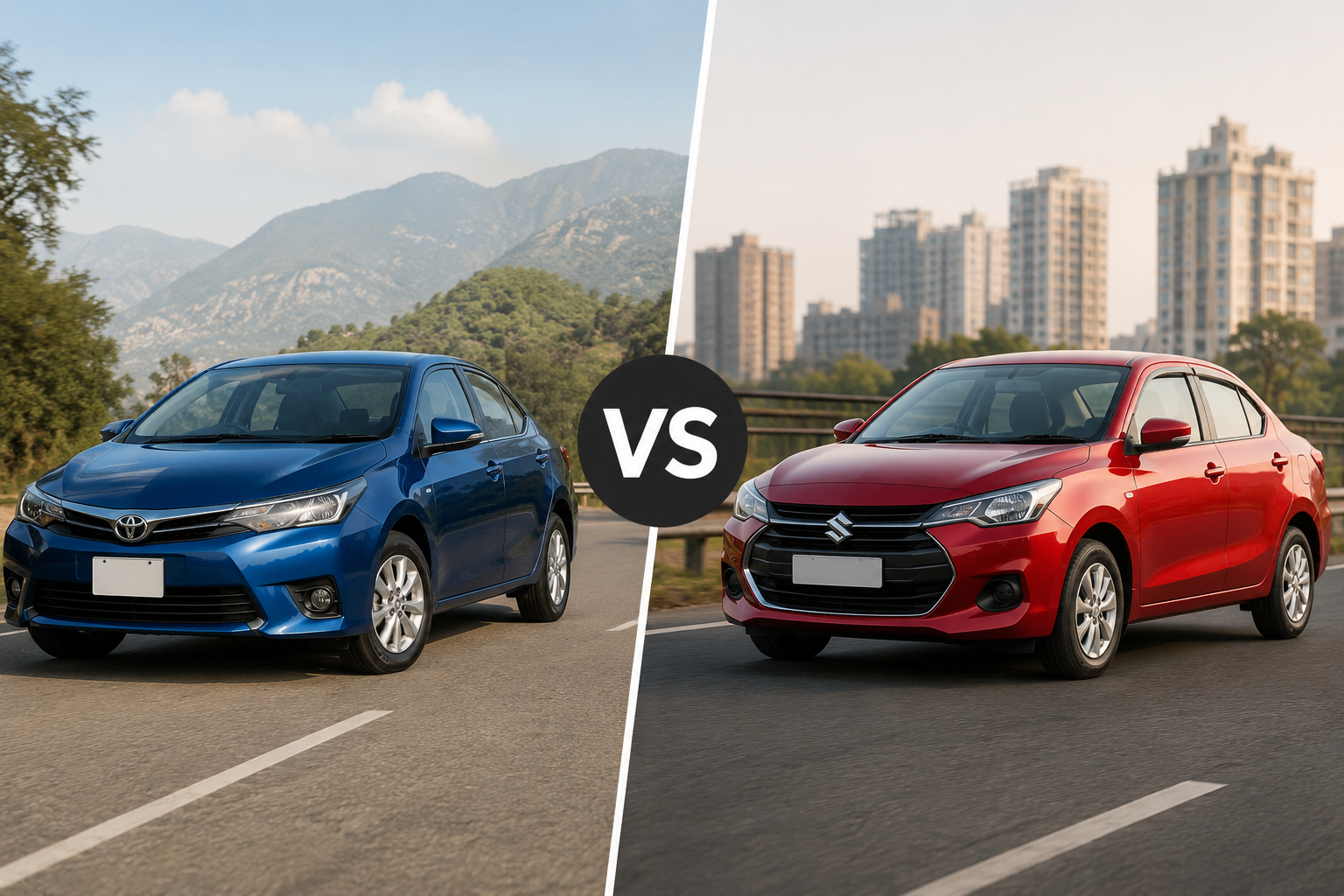
Japanese Imported Cars vs Locally Assembled — Which Makes More Sense in 2026?
Let me be honest with you. I spent three weekends visiting car dealers in Lahore before writing this. Talked to mechanics in the city. Argued with my cousin who swears by his Honda City IVT. And I still wasn't sure what the right answer was — until I started putting actual numbers on paper.
So here it is. No brand loyalty, no sponsored opinions. Just the real picture of what imported Japanese cars versus locally assembled Pakistani cars looks like in 2026.
First, Let's Define What We're Actually Comparing
In Pakistan, when people talk about “Japanese imported cars,” they’re usually referring to used vehicles brought in from Japan after a few years of road use. These are models like the Toyota Aqua, Honda Vezel, Suzuki Wagon R Stingray, and similar cars that arrive through Karachi port after being driven in Japan for around 3 to 7 years.
On the other side are locally assembled cars, built by companies like Suzuki, Toyota Indus, Honda Atlas, and newer entrants such as Changan and MG. This category includes familiar models like the Suzuki Alto and Cultus, Toyota Yaris, Honda City and Civic, as well as cars like the Kia Stonic.
The Price Reality in 2026
Here's where it gets interesting. A 2021 Toyota Aqua imported from Japan will cost you somewhere between PKR 42 to 52 lakh depending on grade, mileage, and the honesty of your dealer. A brand new locally assembled Toyota Yaris 1.3 Automatic? Around PKR 49 to 54 lakh.
On paper, the Aqua seems like a deal — you're getting a hybrid, a more refined car, better fuel economy, and arguably superior build quality for the same or less money.
But that price tag doesn't tell you the whole story.
Import duties on vehicles have not gotten lighter. The government has continued adjusting duty slabs, and by 2026 the landed cost of a JDM unit — including customs duty, regulatory duty, sales tax, income tax, and port charges — has made truly affordable Japanese imports harder to find than they were even three years ago. The days of importing a spotless Aqua for 25 lakh are gone.
Import Duty — The Invisible Tax You Pay at the Beginning
Let's talk about what actually happens when a car arrives from Japan.
A used Japanese car under 1000cc attracts duties that can easily reach 60 to 80% of the assessed value. Cars between 1000cc and 1800cc face even steeper combined tax burdens. And the assessed value — which customs calculates — doesn't always reflect the bargain price you thought you were getting.
By the time a 2020 Honda Fit clears Karachi port through a proper channel, you've paid duties, agent fees, freight, and port handling. If you're going through a dealer, add their margin on top.
The trap many buyers fall into is buying a "duty-paid" imported car from a dealer without understanding what was actually paid and whether the car's paperwork is clean. Underpaid duty, informal clearances, or fabricated invoices can come back to haunt you at registration or resale.
Locally assembled cars? Zero of this headache. You walk into a dealership, get on a waiting list (yes, still), and eventually drive away with factory-fresh documentation, full manufacturer warranty, and no customs ghost following you home.
Depreciation — Who Loses More Money Over Time?
This is one of the most important questions buyers should focus on, even though it often gets ignored.
Locally assembled cars in Pakistan, despite frequent criticism over build quality, tend to hold their value surprisingly well. For example, a 2022 Suzuki Alto that was bought new for around PKR 22 lakh can still sell in the range of PKR 19 to 21 lakh if it’s in good condition. The main reason is consistent demand. New deliveries are often delayed, and buyers who can’t wait are willing to pay strong prices for used cars.
Imported cars behave differently.
Take a 2019 Toyota Aqua, for instance. Someone who paid around PKR 48 lakh in 2022 might only get around PKR 38 to 42 lakh today. That’s a noticeably higher depreciation. Several factors contribute to this: uncertainty about spare parts, increasing availability of newer imported options, and a smaller buyer pool. Not everyone is comfortable paying a high price for a car they feel is harder to maintain or explain to a mechanic.
There’s also a practical angle. Many buyers prefer locally assembled cars because they are easier to service, easier to finance through banks, and more widely understood in the local market. That naturally limits resale demand for imported vehicles.
Of course, there are exceptions. Certain imported models like the Toyota Vezel, Land Cruiser variants, and higher-grade Prado models tend to retain value quite well. But these cases are driven more by status and niche demand rather than the general market trend.
Factor | Locally Assembled Cars | Imported Used Cars |
|---|---|---|
Initial Price | Lower (for same segment) | Higher due to import duties & auction costs |
Depreciation Rate | Slow to moderate | Moderate to high |
Resale Demand | Very strong and broad | Limited but specific |
Market Trust | High (familiar brands & local support) | Mixed (depends on buyer knowledge) |
Spare Parts Availability | Easy and widely available | Sometimes expensive or delayed |
Financing / Bank Loans | Easily approved | Sometimes restricted |
Example Value Retention | Alto: ~85–90% in short term | Aqua: ~75–80% in same period |
Exceptions | High-volume models retain value well | SUVs like Prado/Vezel hold value strongly |
Spare Parts — The Argument That Usually Ends the Debate
Ask any mechanic in Pakistan what frustrates them about Japanese imports, and they'll almost always land on the same thing. Not the cars themselves. The parts.
It's not just about whether a part exists somewhere in the country. It's about whether it'll be there when you need it, whether it'll be the right one, and whether the person fitting it actually knows what they're doing with it. Those three things together are what "parts availability" really means in practice — and on all three, locally assembled cars win by a distance.
Take a 2020 Toyota Aqua. The moment the hybrid battery starts giving trouble — and at some point, most of them do — you're looking at PKR 4 to 6 lakh for a replacement, if you can find a proper one at all. In smaller cities, many workshops won't even attempt a hybrid battery job. Not because they don't want your business, but because the diagnostic tools and the training genuinely aren't there. You can't improvise your way through a high-voltage battery system.
This is where the gap between theory and reality shows up. The repair ecosystem in Pakistan has spent decades building itself around locally assembled cars. A mechanic in Multan has probably fixed more Cultus gearboxes than he can count. In Faisalabad, every second workshop knows the Alto by feel. That kind of familiarity doesn't happen by accident — it builds up over years of the same cars being on the same roads, breaking in the same ways. When a Honda Vezel Hybrid rolls in, even a genuinely experienced mechanic will take a longer pause before opening the bonnet. Not out of incompetence, but because these cars simply haven't been common enough, long enough, to become second nature.
Locally assembled cars don't win this argument by being exciting. They win it by being predictable — and in maintenance, predictable is enormously valuable.
If you're in Karachi or Lahore, you can push back on some of this. Specialist workshops do exist in big cities, they do good work, and hybrid expertise is slowly spreading. But step outside the major cities and the difference stops being theoretical. It becomes very practical, very fast.
There's also something worth noticing about where you get your information on this. Online forums and social media tend to be dominated by urban buyers who've had good experiences with their imports — and often they have. Their cars run well, the fuel economy is real, the features are genuinely better. But the mechanics telling a different story are usually the ones dealing with the aftermath: the sensor that doesn't exist locally, the part that had to be "adjusted" from a donor car, the job that took three weeks instead of three days. Neither side is wrong. They're just describing different versions of ownership — one in ideal conditions, one in the real ones.
Most buyers end up making their decision somewhere in that gap, often without realizing the two conversations aren't quite about the same thing.
Who Should Buy an Imported Car in 2026?
Be honest with yourself before you even open PakCars.
An imported Japanese car makes sense if you're in Karachi, Lahore, or Islamabad — cities where you can actually find someone who knows what they're doing with a hybrid system. It makes sense if you're paying cash, because good luck getting a bank to finance an import without pulling your hair out. It makes sense if you drive a lot — genuinely a lot, not "I go to the office and back" a lot — because that's when the fuel savings stop being a talking point and start showing up in your actual life.
And honestly? It makes sense if you're the kind of person who enjoys the process. Checking auction sheets. Learning what grades mean. Understanding why a grade 4.5 with minor repairs is often better value than a clean grade 3. If that sounds like homework to you, then imports probably aren't your thing.
One more thing people don't say enough: these cars reward long-term ownership. If you're the type who changes cars every two or three years, the imported route will almost certainly cost you more in the end, not less.
Who Should Buy Locally Assembled?
Honestly, most people.
I know that's not what anyone wants to hear. Locally assembled cars aren't exciting. They're not the conversation starter at a family dawat. But they are, for the vast majority of buyers in Pakistan, the more sensible choice — and I say that as someone who spent weeks trying to talk myself into an Aqua.
They make sense if you live outside a major city. If your mechanic is the guy who's been fixing your family's cars for fifteen years and you actually trust him. If you're financing. If you have kids and a job and don't have the bandwidth to chase a part that may or may not arrive from some importer in three weeks.
Locally assembled cars are for people who want to own a car, not manage one. There's real value in that, even if it doesn't show up in any spec sheet.
What I Actually Concluded
I'll be straight with you: I went into this research leaning toward imports. The fuel economy, the features, the build quality — on paper, the case is strong. And for the right buyer, it still is.
But after all the numbers, all the conversations, all the arguing with my cousin — I came out the other side with more respect for the boring choice than I expected.
For most buyers in most cities, locally assembled cars are just easier to live with. Not better on paper. Easier in real life. And in Pakistan, those two things are very different.
Imported cars aren't a shortcut. That's the part that gets people. They see the fuel economy figures, hear someone talk about how their Aqua runs on nothing, and assume the savings will cover everything else. Sometimes they do. Often they don't — not once you factor in the duty, the clearing, the parts, the uncertainty.
The disappointment usually doesn't come from the car itself. It comes from going in with the wrong expectations.
So in the end, it's not really about which car is better. It's about which problems you're more equipped to handle. Because in this market, every choice comes with problems — the question is just which ones you'd rather deal with at two in the afternoon on a Tuesday when something goes wrong.
The smartest decision isn't always the most exciting one. But it's usually the one you stop thinking about after you've made it.
Leave a Comment
Your comment will appear after moderation.