Electric Cars Are the Future. But Are We Seeing the Whole Picture?
Electric vehicles have become the biggest revolution the automotive world has seen in decades.
Governments promote them.
Automakers invest billions into them.
Environmental groups support them.
And social media often presents them as the perfect replacement for traditional gasoline-powered cars.
Cleaner.
Smarter.
Cheaper to run.
Better for the planet.
At least, that's the story most people hear.
But every technological revolution has two sides.
And while electric vehicles offer incredible advantages, there are also important questions that rarely receive the same attention.
Questions about battery production.
Questions about charging infrastructure.
Questions about software dependency.
Questions about long-term ownership.
And perhaps the biggest question of all:
Are electric cars really as environmentally friendly as many people believe?
This isn't an attack on electric vehicles.
Nor is it a defense of gasoline engines.
It's simply a look at the side of the EV revolution that often stays hidden behind the excitement.
Because understanding both sides of the story matters.
The Battery Problem Begins Long Before the Car Is Built
When people think about emissions, they usually imagine what comes out of the exhaust pipe.
Electric cars don't have exhaust pipes.
And that's one of their greatest advantages.
But emissions don't start when a vehicle begins moving.
They start during manufacturing.
Modern EV batteries require materials like:
Lithium
Cobalt
Nickel
Graphite
Manganese
Mining these materials is a massive industrial process.
And like any mining activity, it comes with environmental costs.
Large amounts of energy are required.
Water consumption can be significant.
And mining operations can affect local ecosystems.
Some critics argue that the environmental impact of battery production is often overlooked.
Supporters of EVs point out that, over the vehicle's lifetime, lower operating emissions can offset much of this impact.
Both perspectives contain valid points.
Which is exactly why the discussion is more complicated than simple headlines suggest.
Charging Anxiety Is Real
One of the biggest fears among potential EV buyers isn't battery life.
It's uncertainty.
Traditional gasoline cars have spoiled us.
Fuel stations are everywhere.
Refueling takes five minutes.
And most drivers never worry about whether they'll reach their destination.
Electric cars change that experience.
Even though battery ranges continue improving, many owners still experience what experts call "range anxiety."
Questions constantly appear in the back of their minds:
Will I make it home?
Is the charging station available?
What if the charger isn't working?
How long will I have to wait?
For people who mostly drive in cities, these concerns may not matter.
But for frequent travelers or those living in areas with limited infrastructure, charging anxiety remains one of the biggest barriers to EV adoption.
Technology is improving rapidly.
But convenience still matters.
And for many drivers, convenience shapes purchasing decisions more than anything else.
Waiting Is Something Drivers Are Not Used To
Filling a gasoline tank takes only a few minutes.
Charging an electric vehicle is different.
Fast chargers have become significantly better.
Yet even the fastest chargers require time.
And time changes habits.
Road trips suddenly require planning.
Unexpected detours become more complicated.
Long-distance travel becomes less spontaneous.
Some owners adapt easily.
Others miss the simplicity of traditional refueling.
The difference isn't necessarily good or bad.
It's simply different.
And humans often underestimate how much they value convenience until it's gone.
Modern EVs Depend Heavily on Software
Cars are becoming computers on wheels.
Electric vehicles have accelerated that transformation.
Software controls:
Battery management
Charging systems
Navigation
Driver assistance
Climate control
Performance settings
Safety features
This level of intelligence brings incredible benefits.
Over-the-air updates can improve efficiency.
New features can appear without visiting a dealership.
Problems can be fixed remotely.
But software dependency also creates new risks.
A software bug can affect vehicle functions.
Connectivity problems can interrupt services.
And owners increasingly depend on manufacturers for updates and support.
In some ways, cars are starting to resemble smartphones.
And just like smartphones, they can experience glitches.
For many traditional car enthusiasts, this shift feels both exciting and slightly uncomfortable.
What Happens When the Battery Ages?
Every battery degrades over time.
It's unavoidable.
Modern battery technology is improving, and most EV owners won't experience major issues for many years.
But eventually, battery capacity declines.
This raises understandable questions:
How expensive is replacement?
Will battery technology become obsolete?
Will replacement parts remain available?
For buyers planning to keep a vehicle for ten or fifteen years, these concerns matter.
Fortunately, battery warranties have become increasingly generous.
And battery technology continues advancing.
Still, uncertainty about long-term ownership remains one of the biggest questions surrounding electric vehicles.
The Resale Value Question
Used car buyers often understand engines.
They know mileage.
They know maintenance history.
Battery health, however, is still unfamiliar territory for many people.
As a result, some used EV buyers hesitate.
Questions arise:
How much battery capacity remains?
Has the battery been properly maintained?
Will future repairs be expensive?
Because electric vehicle technology evolves so quickly, older models can sometimes feel outdated sooner than traditional vehicles.
A new battery breakthrough or major range improvement may suddenly make previous generations less desirable.
This uncertainty affects resale values.
And for buyers who frequently change vehicles, resale value can be just as important as purchase price.
Are Electric Cars Truly Zero-Emission?
This is one of the biggest misconceptions.
Electric vehicles are often described as zero-emission vehicles.
Technically, that's true while driving.
But electricity itself must come from somewhere.
Depending on the country, electricity may be generated by:
Renewable energy
Natural gas
Coal
Nuclear power
Hydroelectric plants
In regions heavily dependent on fossil fuels, the overall environmental picture becomes more complex.
This doesn't mean EVs are ineffective.
Far from it.
But it does mean that environmental benefits depend heavily on how electricity is produced.
The cleaner the grid becomes, the cleaner electric vehicles become.
And that's an important distinction.
Extreme Weather Still Creates Challenges
Cold weather affects battery performance.
Hot weather can also influence efficiency.
Temperature plays a larger role in electric vehicles than many people realize.
Winter conditions may reduce driving range.
Air conditioning and cabin heating consume additional energy.
Charging speeds can also change depending on temperature.
Most owners adapt quickly.
But these realities surprise many first-time EV buyers.
Again, it's not necessarily a flaw.
It's simply something consumers should understand before making decisions.
The Silent Problem Nobody Talks About
Electric cars are incredibly quiet.
For drivers, this creates comfort.
But silence introduces new concerns.
Pedestrians, cyclists, and visually impaired individuals often rely on sound to detect approaching vehicles.
This issue became significant enough that many countries now require electric vehicles to produce artificial warning sounds at low speeds.
Ironically, engineers are adding noise to vehicles that were originally celebrated for being silent.
Sometimes progress creates unexpected challenges.
The Future Is Electric. But The Journey Won't Be Perfect
Despite all these concerns, electric vehicles are here to stay.
Battery technology is improving.
Charging networks are expanding.
Software continues evolving.
And infrastructure grows stronger every year.
None of the challenges discussed here mean electric vehicles are a bad idea.
Nor do they suggest gasoline engines are superior.
Every technology has strengths and weaknesses.
The important thing is understanding both.
Because informed consumers make better decisions.
And no technology becomes successful by ignoring its limitations.
Final Thoughts
Electric vehicles represent one of the most exciting transformations in automotive history.
They're faster.
Cleaner.
Smarter.
And increasingly practical.
But like every major innovation, they come with trade-offs.
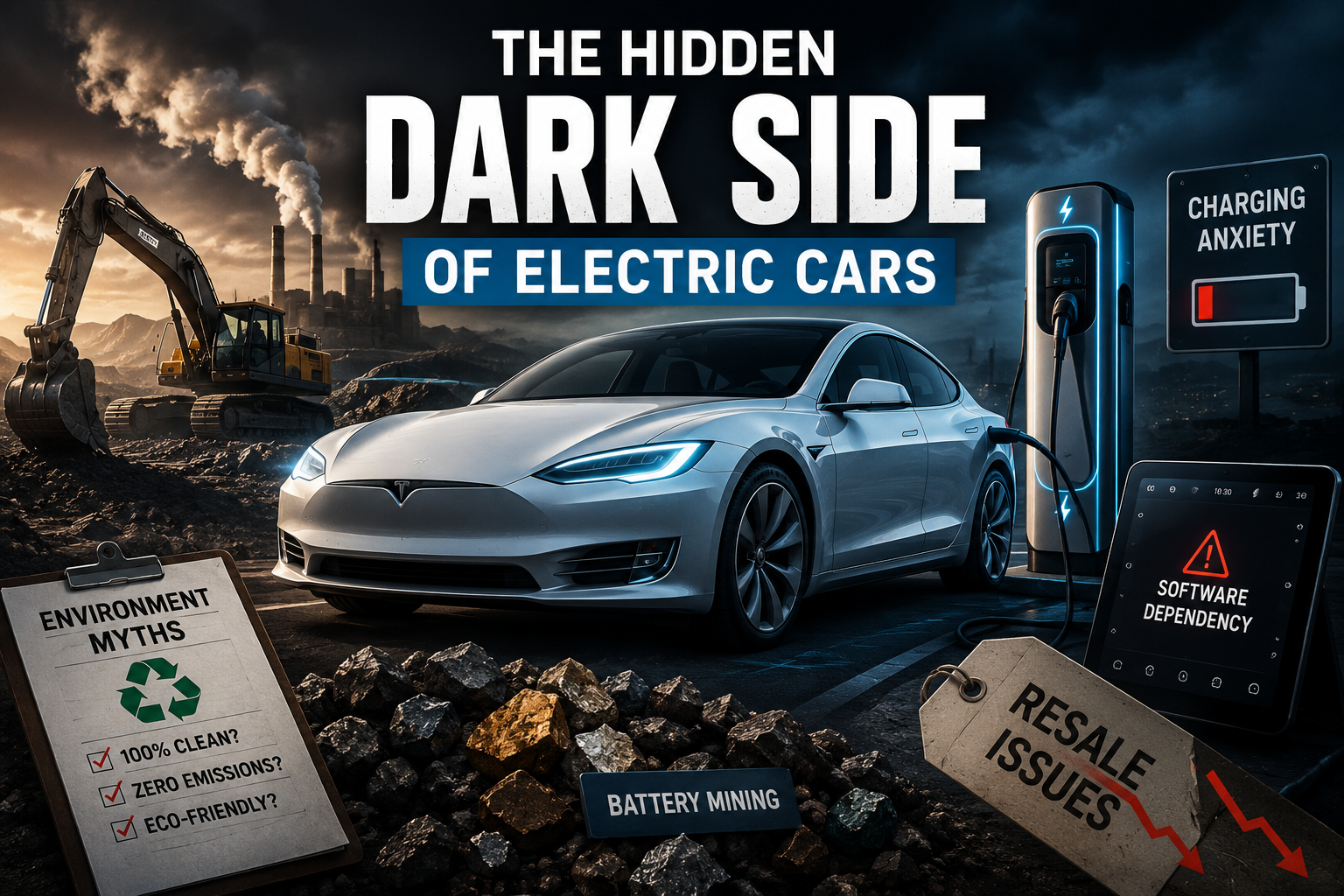
Battery mining.
Charging anxiety.
Software dependency.
Resale concerns.
Environmental complexities.
These issues don't mean the electric revolution is failing.
They simply remind us that progress is rarely perfect.
Perhaps the future isn't about choosing sides.
Perhaps it's about finding balance.
Because the most important conversations are often the ones nobody wants to have.
And sometimes, the hidden side of a story is just as important as the part everyone celebrates.
Leave a Comment
Your comment will appear after moderation.